
Hungarian Parliament Building from the Danube
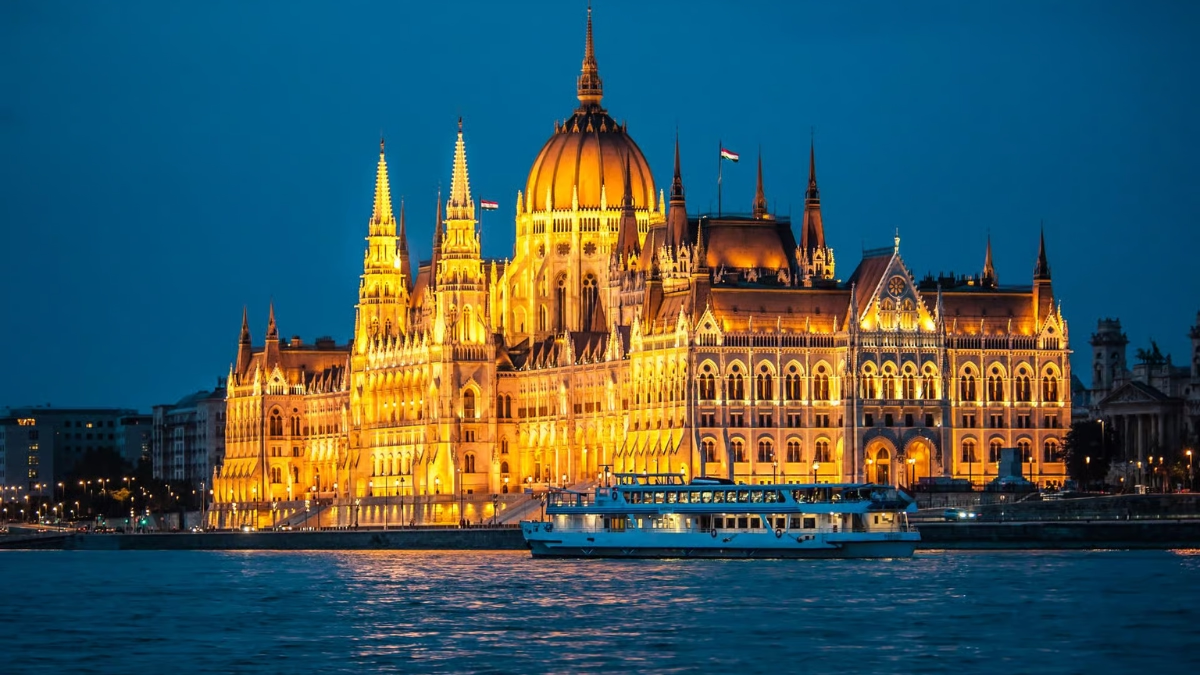
The Hungarian Parliament Building (Országház) stands on the eastern bank of the Danube in Pest and is the defining landmark of any Budapest river cruise. Completed in 1904 and designed by architect Imre Steindl in neo-Gothic style, it is 268 m long, 96 m high, and contains 691 rooms. From the Danube, you see the full extent of its riverside façade — something impossible from street level. At night, the building is floodlit in warm gold, and its reflection on the dark water below creates one of the most photographed river views in Europe.
The Hungarian Parliament Building is the landmark every visitor to Budapest wants to see — and the Danube River is the place to see it from. This guide explains what you are looking at, why the river view is the one that matters, and what to expect at different times of day.
Why the View from the River Is the Best View
The Hungarian Parliament Building stretches for 268 metres along the Pest embankment of the Danube — nearly three times the length of a football pitch. From street level, you see a fragment of this. From Kossuth Square behind the building, you see the main entrance façade. But from the middle of the Danube, you see the entire riverside elevation simultaneously: the central dome flanked by symmetrical wings, the 96-metre spires, and the intricate neo-Gothic stonework across the full width of the building.
This is the view the architect intended. Imre Steindl oriented the building to face the Danube precisely because this was always Budapest’s grandest public stage — the waterway visible from both banks, approached by river traffic from across Europe. A Danube cruise restores that original perspective.
St. Stephen’s Basilica Budapest — History and Architecture
Origins and Design
The decision to build a new Hungarian parliament was made in 1880, when Hungary was part of the Austro-Hungarian Empire and in the midst of a period of intense national awakening. A public competition was held, and Imre Steindl’s neo-Gothic design was selected — inspired partly by the British Houses of Parliament in London, another riverside parliament building. Construction began in 1885, and the building was inaugurated in 1896 to coincide with Hungary’s millennium celebrations — the 1,000th anniversary of the Hungarian state — though construction was not fully completed until 1904. Tragically, Steindl lost his sight before the building was finished and never saw his masterpiece completed.
The Symbolism of 96 Metres
The building’s height of exactly 96 metres is not coincidental. It references the year 896, when the Magyar tribes settled in the Carpathian Basin — the foundational moment of the Hungarian state. The same height was deliberately adopted for St. Stephen’s Basilica across the city, expressing the principle that worldly and spiritual power in Hungary are equal in importance. Budapest’s skyline regulations long prohibited any building from exceeding 96 metres, which is why the Parliament and the Basilica dominated the city horizon for over a century.
The Interior
The Parliament contains 691 rooms, 29 staircases, 10 courtyards, and a library of more than 500,000 books. Its most famous interior space is the Dome Hall, where Hungary’s Crown Jewels — the Holy Crown of St. Stephen, Hungary’s most sacred national symbol — are displayed under permanent guard. Tours of the interior last approximately 45 minutes and are available in multiple languages, though English-language slots sell out 2–4 weeks in advance in summer.
World War II and the Cold War
The Parliament survived World War II relatively intact compared to many Budapest landmarks, though the area around it suffered severely. During the 1956 Hungarian Revolution, the square in front of the Parliament — Kossuth Square — was the site of one of the most tragic events of the uprising. A memorial to the victims of October 25, 1956, now stands in the square alongside statues of Lajos Kossuth and other national figures.
Parliament Building View from the Danube: Day vs Night
By day, the Parliament’s pale limestone façade catches the light differently throughout the day — warm gold in the morning, brilliant white at noon, and a soft amber as the afternoon fades. The full architectural detail is visible: the Gothic tracery, the arched windows, the rows of statues on the roofline. Natural light is better for photography and for appreciating the building’s stonework.
By night, the Parliament transforms. Hundreds of individual spotlights pick out every pinnacle, parapet, and spire. On a calm evening, the entire floodlit façade reflects on the dark Danube below — a mirror image of gold and shadow. This is the image that appears in every travel magazine spread about Budapest, and it genuinely looks exactly like the photographs in person.
The city monument lighting switches off at 10 PM, so choose evening cruise departures between 8 PM and 9:30 PM in summer to see the full display.
Which Budapest Danube Cruises Pass the Parliament Building?
Every Budapest city cruise passes the Parliament Building — it is the northern anchor of the downtown cruise route. Some operators pass close to the Pest bank (giving a near-vertical view of the façade); others approach from a wider midstream angle (giving the full panoramic view with both banks visible). The Danube 4-Course Dinner Cruise + Live Folk Music includes the Parliament as one of ten named landmark stops on its comprehensive route.
For the Parliament from the water as part of a broader Budapest evening, the Danube River Candlelit Dinner Cruise by Legenda Cruises is particularly praised — the glass-ceiling boat design means you can see the Parliament lit above you as the boat passes close to the embankment.
Practical Information — Visiting the Interior
The Parliament interior is open to guided tours (45 minutes, multiple languages). Tickets are available online at the official website (parlament.hu) or at the visitor centre near the main entrance. English tours sell out 2–4 weeks ahead in summer — book online in advance. The building is closed on Hungarian national holidays (March 15, August 20, October 23) and during full National Assembly sessions.
Address: Kossuth Lajos tér 1-3, 1055 Budapest (M2 metro — Kossuth Lajos tér station, or Tram 2 along the riverfront)
Frequently Asked Questions
Is it better to see the Parliament Building during a day cruise or an evening cruise?
Day cruises show the Gothic Revival architectural details and the Danube’s full landscape, while evening cruises (ideally around sunset or after dark) offer dramatic lighting that transforms the building into a glowing spectacle. Choose based on whether you want to see the intricate stonework or the romantic nighttime glow.
Can I visit the inside of Parliament during a Danube cruise, or do I need to book separately?
Interior tours must be booked separately—cruises only pass by the building from the river. You’ll need to schedule a guided tour or buy individual tickets in advance, as Parliament only offers visits on authorized tours and has limited daily capacity.
How close does a Danube cruise actually get to the Parliament Building?
Most cruises pass directly in front of the building from the water, typically 50–100 meters away, giving you a clear, unobstructed view of the entire facade. Some premium cruises that slow down for sightseeing offer even better viewing windows.
What should I look for on the Parliament Building’s exterior that makes it special architecturally?
From the river, you can see the distinctive twin Gothic towers, the copper roof (turned green with age), and the intricate stone carvings along the 268-meter facade—the building took 18 years to complete and incorporates Renaissance, Gothic, and Baroque elements visible from every angle.
Are there any Danube cruises that focus specifically on Parliament and historic buildings?
Yes—longer cruises (2–3 hours) and themed historical tours often stop or slow substantially at Parliament, while quick 1-hour cruises may only pass it briefly. Check tour descriptions for ‘Parliament Building’ or ‘historic architecture’ focus before booking.
Do I need to time my visit to Parliament’s interior tours around cruise schedules?
No—interior tours are independent of river cruises and run on their own schedule. Plan your river cruise and Parliament visit separately; most visitors combine them on the same day but at different times.
