
Gellért Hill & Citadel as Seen from the Danube
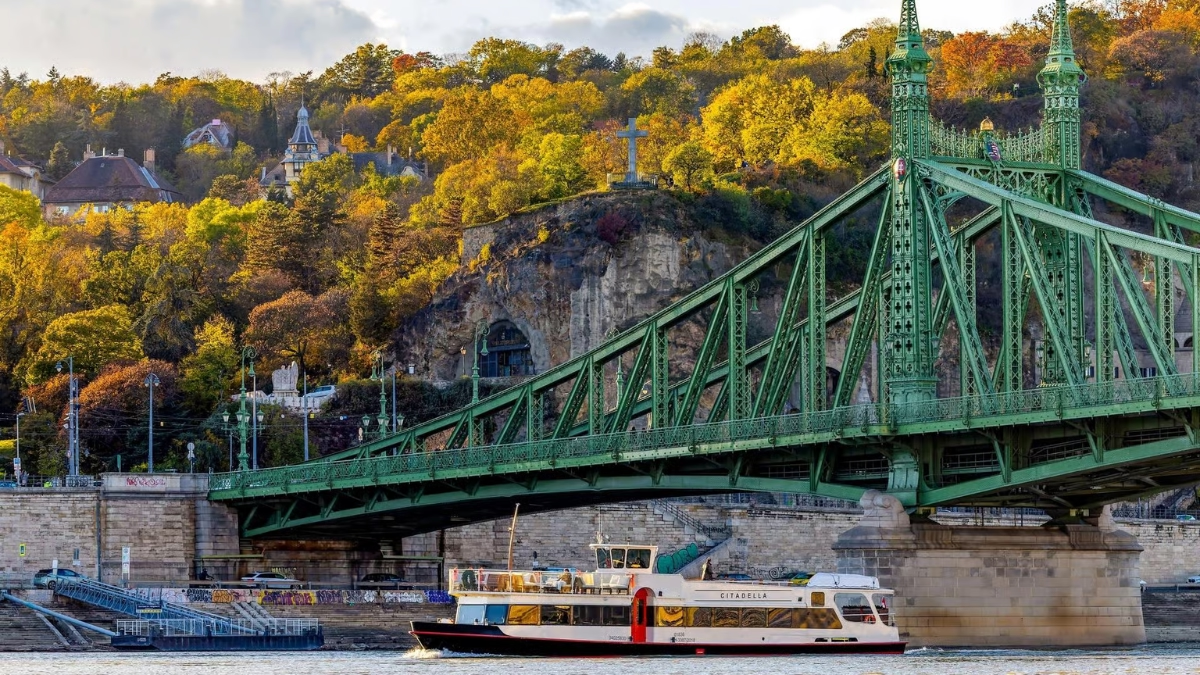
Gellért Hill (Gellért-hegy) is a 235-metre dolomite rock rising directly above the Danube on the Buda side, about 1 km south of the Chain Bridge. Its peak is crowned by the Citadel — a Habsburg fortress built in 1854 — and the Liberty Statue (Szabadság-szobor), a 14-metre bronze female figure erected in 1947, now a symbol of Budapest’s freedom. From a Danube cruise, Gellért Hill and the Liberty Statue are visible for the full southern portion of the city route — the largest single natural landmark on the Budapest riverfront. The Citadel reopened after a major renovation in April 2026 as an open public park.
Gellért Hill rises sharply above the Danube at the southern end of Budapest’s central river cruise route — a 235-metre rock crowned by a Habsburg fortress and the Liberty Statue. It is the most dramatic natural landmark on the Budapest waterfront, visible for most of any city cruise.
Margaret Island — What You See from a Danube Cruise
Gellért Hill is the most dramatic natural landmark on the Budapest Danube riverfront. Unlike Buda Castle (which is built on a hill) or the Parliament (which rises from the flat Pest embankment), Gellért Hill is solid rock — a sheer dolomite outcrop that drops steeply to the water’s edge at the southern end of the city cruise route.
From a Danube cruise, the hill provides a constant backdrop to the southern portion of the route. At its foot, the elegant Gellért Hotel and the Gellért Thermal Baths face the Liberty Bridge. Midway up the hillside, a bronze statue of Bishop Gellért watches over the Elizabeth Bridge below. At the summit, the Citadel’s old stone walls are now open as a park, and the Liberty Statue’s arm raises a palm leaf skyward — visible from kilometres away.
At night, the Liberty Statue is floodlit, and its silhouette against the dark sky is one of the most striking features of any Budapest night cruise.
Gellért Hill and Citadel Budapest — History
Bishop Gellért and the Hill’s Name
The hill is named after Bishop Gellért (Gerard of Csanád), a Venetian Benedictine monk who came to Hungary around 1000 AD at the invitation of King Stephen I to help convert the Hungarians to Christianity. In 1046, during a pagan uprising after Stephen’s death, Gellért was captured, placed in a spiked barrel, and rolled down the hill into the Danube. He was later canonised as a martyr. His statue — holding a cross, facing the Elizabeth Bridge below — stands on the northeastern slope of the hill.
The Citadel — A Habsburg Symbol of Control
The Citadel was built by the Habsburgs between 1850 and 1854, following the suppression of the 1848–49 Hungarian Revolution. Its purpose was explicitly to control rather than protect the city — its cannon positions covered both Buda and Pest, a constant reminder of Austrian domination. Hungarians at the time called it the “Budapest Bastille.” The fortress lost its military role by the end of the 19th century and was partially symbolically demolished when the Habsburgs handed it to the city. It served various functions over the following decades — including as an anti-aircraft battery in World War II and a hotel in the communist period — before falling into neglect. A full renovation completed in April 2026 has transformed it into an open public park with panoramic terraces.
The Liberty Statue — A Complex Symbol
The 14-metre bronze female figure holding a palm leaf at the top of the hill was erected in 1947, originally commissioned by the Soviet authorities to commemorate the Red Army’s liberation of Budapest from the Nazis. Over time, its meaning has been reinterpreted — the Soviet soldier originally at its base was removed in 1992, and the inscription now reads “To the memory of those who sacrificed their lives for the independence, freedom, and prosperity of Hungary.” The statue remains one of Budapest’s most visible and beloved landmarks, its silhouette recognisable from across the city.
Panoramic View of Budapest from Gellért Hill
The panorama from the Citadel at the top of Gellért Hill is considered the finest city-wide view in Budapest — better than Fisherman’s Bastion (which focuses on the Parliament and the opposite bank) because here you see the full sweep of both banks simultaneously, including the Danube bridges, Buda Castle, and the flat expanse of Pest stretching to the horizon.
Visiting Gellért Hill and the Citadel Budapest
The hill is freely accessible at all hours. Walk up from Gellért Square (M4 metro — Szent Gellért tér, or trams 4 and 6) via the hillside paths — about 20–30 minutes on foot. The Liberty Statue and the Citadel park are at the summit.
At the foot of the hill, the Gellért Thermal Baths (closed for renovation until 2028) and the Cave Church (open daily) are worth visiting before or after the ascent. The Liberty Bridge itself — the elegant green ironwork bridge at the south end of the cruise route — is worth walking across as an approach to the hill.
Frequently Asked Questions
How do I get to the top of Gellért Hill?
You can climb the walking trails from the base (about 20 minutes), use the chairlift for a partial ascent, or drive to a parking area near the Citadel. Most visitors combine walking with the views for the best experience.
Is there an entrance fee to visit the Liberty Statue or Citadel?
No—the Liberty Statue monument and the exterior of the Citadel fortress are free to visit and explore. You only pay if you choose to enter paid attractions or museums within the Citadel complex.
What can you actually see from the top of Gellért Hill?
On clear days, you get panoramic 360-degree views of Budapest, including Parliament Building, Chain Bridge, Margaret Island, the Danube snaking through the city, and the landscape extending to the horizon. It’s one of Budapest’s premier viewpoints.
Will I see Gellért Hill and the Liberty Statue on a Danube river cruise?
Yes—the article notes it’s the most dramatic natural landmark on the waterfront and visible throughout most river cruises. The 235-metre hill, Citadel, and Liberty Statue are prominent visual landmarks from the water.
How long should I plan to spend at Gellért Hill?
Plan 1–2 hours total: 20–30 minutes for the ascent, and 30–60 minutes to explore the top, photograph the views, visit the Liberty Statue, and walk around the Citadel exterior.
Why was the Citadel built on Gellért Hill?
The Habsburg fortress was built after the 1848 revolution to control Budapest from a strategic high point overlooking the Danube and city. The 235-metre elevation made it an ideal defensive position.
